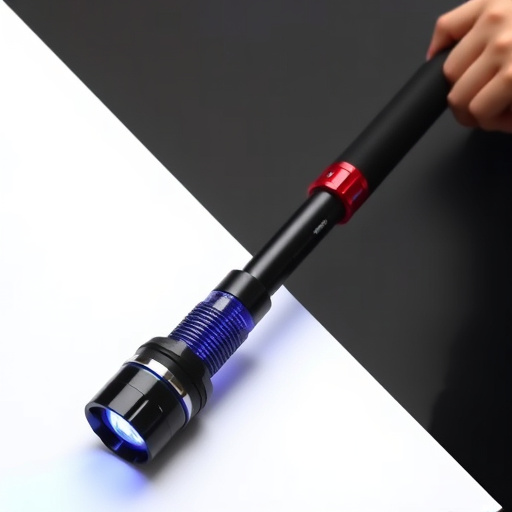
Mastering tactical baton retention is crucial for those carrying a self-defense telescoping baton, ensuring control and stability during high-stress situations. This involves using all five fingers and a strong thumb grip for firm retention and quick movements. Optimizing carry positions, such as waist level or lower, allows for easy retrieval with balanced weight distribution. Advanced techniques like the "wrist lock" enable officers to handle aggressive subjects effectively while training and experience are vital for sophisticated skill execution in real-world scenarios. Regular practice with rapid extension and retention drills enhances muscle memory and safe baton control.
In the realm of self-defense equipment, the tactical telescoping baton stands as a versatile tool for civilians and professionals alike. Understanding tactical baton retention and carry positions is paramount for effective deployment in high-stress situations. This article delves into the fundamentals of grip and control, explores advanced self-defense tactics with the telescoping baton, and provides practical training drills to ensure mastery. By mastering these techniques, individuals can optimize their carry positions, enhancing accessibility and ensuring readiness when facing threats.
- Understanding Tactical Baton Retention: The Basics of Grip and Control
- Self-Defense Tactics: When and How to Employ the Telescoping Baton
- Optimizing Carry Positions: Ensuring Ease and Accessibility
- Advanced Techniques: Retaining Control in Challenging Situations
- Training and Practice Drills for Effective Baton Retention
Understanding Tactical Baton Retention: The Basics of Grip and Control
Tactical baton retention is a critical skill for anyone carrying a self-defense telescoping baton. The key to effective retention lies in mastering the basics of grip and control. A secure grasp on the baton ensures it remains in your hand during high-stress situations, preventing unexpected drops or dislodging.
Proper grip involves using all five fingers to wrap around the baton’s handle, with a strong thumb position providing additional stability. This technique, often referred to as a ‘grip and control’ method, allows for firm retention while also enabling quick and precise movements. By understanding the right grip and practicing consistent control, individuals can maximize their tactical baton’s potential in self-defense scenarios.
Self-Defense Tactics: When and How to Employ the Telescoping Baton
In self-defense scenarios, tactical batons, particularly their telescoping variants, offer a concealed yet powerful tool for personal protection. The self-defense telescoping baton is designed to be easily hidden within the hands or in pockets, making it an inconspicuous defense mechanism that can quickly deploy when needed. When faced with a threat, users can extend the baton with rapid and subtle movements, creating a psychological deterrent against potential aggressors.
The tactical telescoping baton’s versatility lies in its ability to adapt to various situations. It can be employed as a striking tool, delivering powerful blows with surprising speed and force. The baton’s extension mechanism allows for a calculated approach, enabling users to gauge the distance and intensity of their response. Additionally, the telescoping design facilitates easy storage, ensuring it remains readily available when required, making it an ideal self-defense option for individuals seeking a discreet yet effective solution.
Optimizing Carry Positions: Ensuring Ease and Accessibility
Optimizing carry positions for a self-defense telescoping baton is paramount for ensuring both ease and accessibility during critical moments. The ideal position should allow for quick, one-handed retrieval, balancing weight distribution evenly across your body to minimize strain. Consider keeping it within easy reach, like at waist level or slightly lower, where it can be readily grabbed without causing a hindrance to other tasks or movements.
Experiment with different holsters and belts that cater to various carrying styles—side carry, crossbody, or even behind-the-back—to find what feels most comfortable and practical for your everyday activities. The goal is to make the baton an extension of your body, ready to deploy instinctively when needed, without compromising comfort or mobility.
Advanced Techniques: Retaining Control in Challenging Situations
In high-pressure situations, mastering advanced techniques for tactical baton retention is invaluable. When dealing with aggressive or resistant subjects, the self-defense telescoping baton can be a powerful tool for control and de-escalation. One such technique involves using the baton’s extension and retraction to gain purchase and maintain balance, allowing officers to keep a firm grip despite struggle. By combining precise movements with strategic body positioning, law enforcement personnel can effectively manage challenging encounters while ensuring their safety.
These advanced methods often incorporate dynamic adjustments to standard retention strategies. For instance, when facing a large or physically dominant assailant, tactical officers may employ a “wrist lock” technique during baton deployment. This involves securing the opponent’s wrist with the baton, limiting their mobility and providing crucial time for further de-escalation tactics. Such sophisticated skills require rigorous training and practical experience to execute effectively in real-world scenarios, making them essential components of modern law enforcement self-defense strategies.
Training and Practice Drills for Effective Baton Retention
Effective baton retention and carry positions are crucial skills for anyone training with a self-defense telescoping baton. Regular practice is key to mastering these techniques, ensuring quick deployment and secure control during stressful situations. Incorporate a variety of drills into your training regimen to simulate real-world scenarios and improve muscle memory.
One effective drill involves practicing rapid extension and retention. Stand in a safe, open area and have a partner hold the baton at arm’s length. Practice quickly extending and locking the baton in place with one hand while maintaining control with the other. Focus on keeping your grip firm but not too tight to avoid injuries. Gradually increase the distance and difficulty as you become more comfortable with the motion.
Tactical baton retention is a vital skill for those involved in self-defense with a telescoping baton. By understanding the basics of grip and control, learning effective self-defense tactics, optimizing carry positions, and mastering advanced techniques, you can ensure that your baton remains securely in your hands during challenging situations. Regular training and practice drills are essential to developing this crucial skill set, enabling you to confidently navigate dangerous scenarios with a self-defense telescoping baton.